
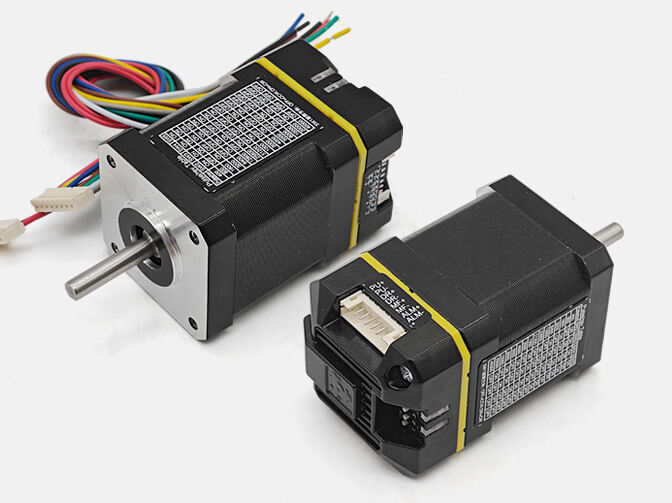
Hybrid servo motors have revolutionized the world of motion control, merging the strengths of both traditional DC motors and Closed Loop Steppers Motors & Drivers. Over the past few decades, they have undergone significant evolution, advancing in terms of efficiency, performance, and versatility. These motors play a pivotal role in industries ranging from robotics to manufacturing, aerospace, and automotive applications. Understanding the evolution of hybrid servo motors provides insights into their growing impact on modern technology and automation.
The Birth of Hybrid Servo Motors
Hybrid servo motors emerged in the 1980s as a solution to the growing demand for precise motion control in automation. The term "hybrid" refers to the fusion of the characteristics of both DC and AC motors. Traditionally, DC motors were favored for their precise control and high torque at low speeds, but they suffered from maintenance issues due to brushes and commutators. On the other hand, AC motors were known for their durability and energy efficiency but lacked fine control at low speeds.
The hybrid servo motor sought to combine the best of both worlds. By integrating a permanent magnet synchronous motor (PMAC) with a feedback system, these motors provided the high torque and precision of a DC motor with the efficiency and low maintenance of an AC motor. The early hybrid models were designed for use in applications where speed, accuracy, and reliability were paramount.
Advancements in Technology
As technology progressed, so did the capabilities of hybrid servo motors. One of the key milestones in their development was the introduction of digital controllers and advanced feedback systems. These innovations allowed hybrid servo motors to achieve finer control, better speed regulation, and more precise positioning. The integration of encoders and resolvers enabled real-time feedback, allowing these Integrated Stepper Servo Motors to adapt to varying loads and speeds, a feature crucial for industries that rely on automation.
The advent of microprocessors and programmable logic controllers (PLCs) in the late 1990s further enhanced the versatility of hybrid servo motors. With the rise of sophisticated control algorithms, engineers were able to optimize motor performance, leading to significant improvements in energy efficiency, speed, and overall operational lifespan. Hybrid motors began to be employed in applications like CNC machines, robotics, and automated assembly lines, where precise motion and fast response times were critical.
The Rise of Brushless Technology
A significant turning point in the evolution of hybrid servo motors came with the development of brushless motor technology in the 2000s. Traditional hybrid servo motors still used brushes and commutators, which, over time, could wear out and reduce the motor's efficiency. Brushless hybrid servo motors, on the other hand, eliminated this problem by using electronic commutation to control the flow of electricity to the motor windings. This design significantly improved motor reliability and efficiency while reducing maintenance costs.
Brushless technology also contributed to higher power density, allowing hybrid servo motors to deliver more torque in a smaller and lighter package. This made them ideal for industries where space and weight constraints were critical, such as aerospace and automotive applications. The ability to operate at higher speeds and with better thermal management further broadened the scope of hybrid servo motors.
Modern Hybrid Servo Motors: Smart, Efficient, and Scalable
Today, hybrid servo motors are more intelligent and adaptable than ever. With the incorporation of IoT (Internet of Things) technology, these motors can now communicate with other machines and systems in real time, enabling predictive maintenance and more efficient operation. Advances in materials science have also led to improvements in the construction of hybrid motors, making them lighter, more energy-efficient, and capable of handling higher loads.
Moreover, modern Stepper Motor & Drivers s are increasingly scalable, making them suitable for both small-scale applications and large industrial systems. Their versatility and performance improvements have led to widespread adoption in sectors like 3D printing, automotive assembly, and medical devices, where precision and reliability are paramount.
Conclusion
The evolution of Brushless DC Motors & Drivers has been nothing short of transformative. From their inception in the 1980s to their current state as highly advanced, brushless, and smart devices, these motors have reshaped the world of motion control. Their continued development promises even greater efficiency, precision, and versatility, ensuring that they will remain a cornerstone of industrial automation for years to come.
